XDG Design Philosophy
The design of XDG has been largely influenced by the history of DAGMC's design. XDG's design builds upon the success of DAGMC with an extensible design for multiple ray tracers and mesh libraries. The XDG architecture diagram below shows how those responsibilities are organized:
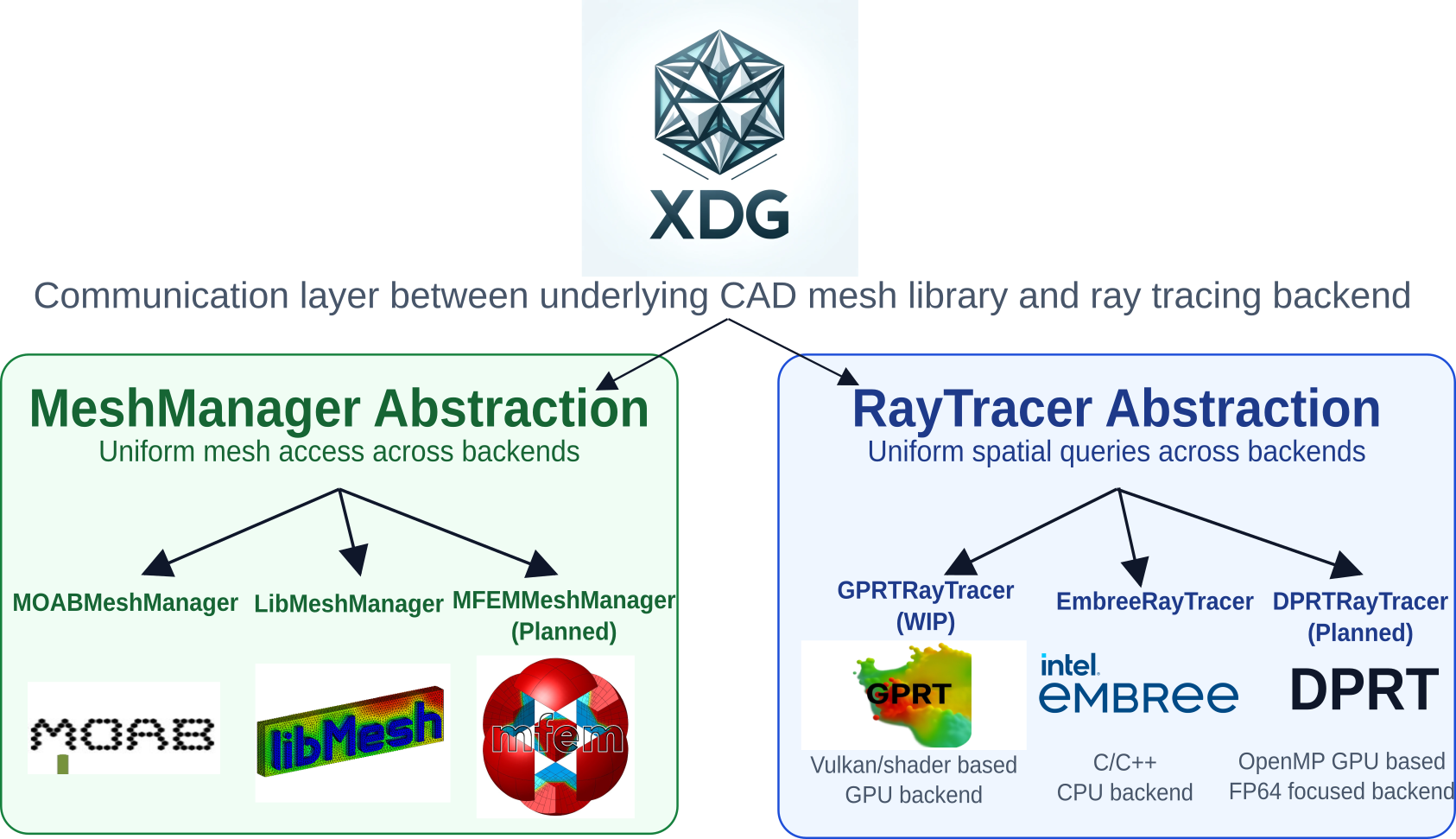
High-level XDG design architecture diagram
The primary design goals of XDG are centered on the following core ideas:
Mesh Library Abstraction: all mesh-based operations in XDG are abstracted through a common interface, the
MeshManagerInterface. This allows for the use of multiple mesh libraries without changing the core XDG codebase. A minimal implementation of the interface can be found in themesh_mock.hfile in the test suite and is only ~100 lines long.Separation of Mesh and RayTracing Implementations: XDG is designed to separate the concerns of mesh interfaces and ray tracing. Mesh libraries often implement their own acceleration data structures and ray tracing algorithms. XDG is designed to build on top of these libraries and provide a common interface for ray tracing operations that works for all of the supported mesh libraries (see Introduction to XDG). This makes the library agile and able to leverage the strengths of multiple mesh libraries along with modern ray tracing algorithms.
Ray Tracing Interface Abstraction: all ray tracing operations in XDG are abstracted through a common interface, the
RayTracingInterface. This allows for the use of multiple ray tracing libraries without changing the core XDG codebase. This is important for one of XDG's primary goals: to support ray tracing on both CPUs and GPUs in a single binary.
For historical context, DAGMC's design and its interaction with the subsequent double-down extension help explain why XDG adopts these abstractions. That earlier design was more tightly coupled to MOAB, and the ray tracing path through double-down was less extensible being a direct interface only to the Embree ray tracing kernels. The older DAGMC/double-down layout is also shown below for comparison:
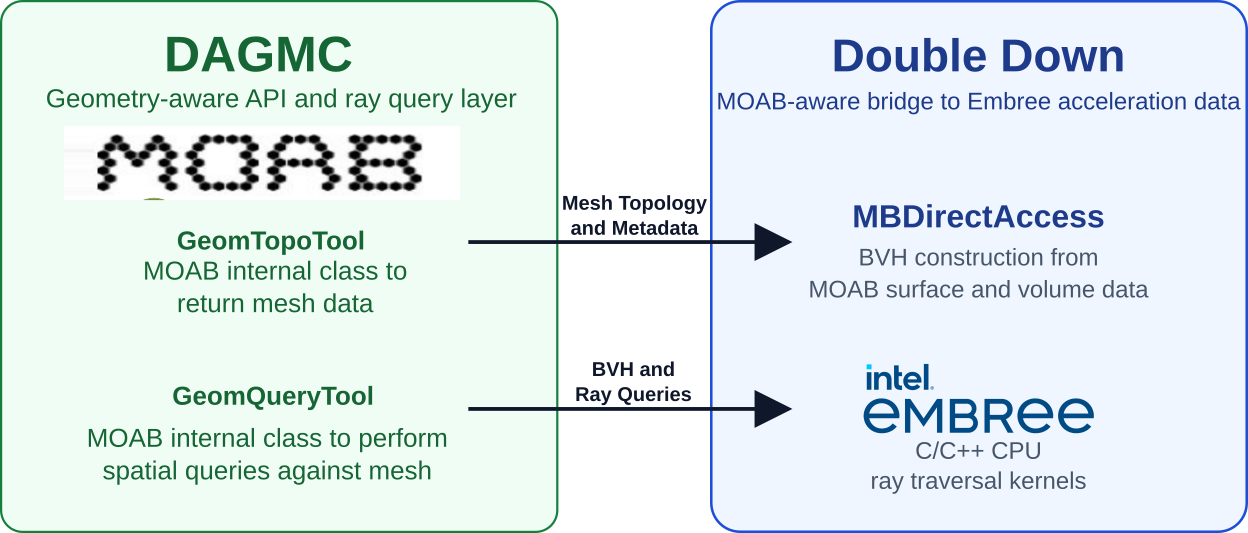
Historical DAGMC design architecture with the double-down ray tracing extension